
Sterling Hayden: Professional Irregular (2019/2026) Philippe Garnier
A review of the new translation from Black Pool Productions

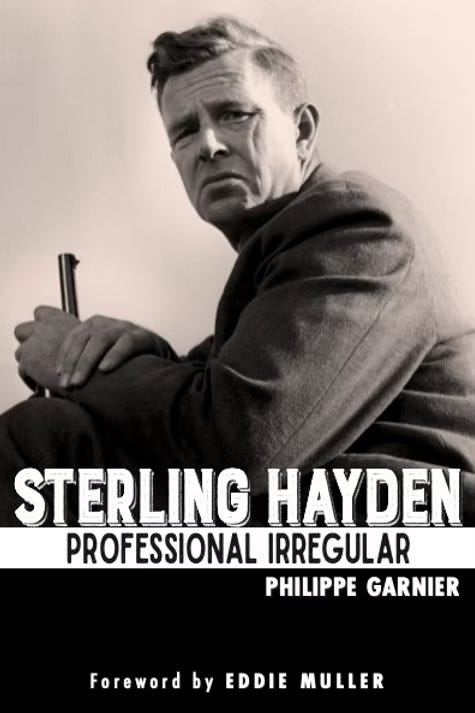
Sterling Hayden: Professional Irregular (2019/2026) Philippe Garnier
Foreword by Eddie Muller
Black Pool Productions, 204 pages with photos
Sterling Hayden: Professional Irregular bothered me. I should’ve seen it coming: It’s all in the book’s title. The man I’d come to admire for his roles in films like The Asphalt Jungle (1950), The Killing (1956), Crime Wave (1954), Terror in a Texas Town (1958), and Dr. Strangelove (1964) was only a small part of Sterling Hayden’s complete picture. If you placed his acting life on a pie chart, it would amount to a fairly thin slice.
In addition to acting, Hayden was also a master sailor, veteran of the armed forces (serving in the Army, Marines, and OSS)1, writer, adventurer, raconteur, husband (three times), father, and HUAC informer. He was also terrible with money.
All these things make for a fascinating man who reveled in a life of adventure and resided in a dark consciousness. Hayden reluctantly made movies to finance his passions for sailing and writing, caring little for Hollywood or the celebrity lifestyle. Garnier quotes Hayden from a 1968 Boston Globe article: “I have no respect for the acting profession. I’m here (filming Hard Contract, 1969) for the money only—which shall enable me to write my novel” (p. 153).
Hayden’s later film career is peppered with some real head scratchers, but knowing he took those roles primarily for the money explains those decisions. Yet you begin to wonder whether he was chosen because he fit the parts, or because he was Sterling Hayden. In many of those pictures, Hayden’s brief appearances justify the only reason to see them.
Actors working with Hayden weren’t always sure how to take him. In his very first film, Eric Roberts nervously approached Hayden to ask how they would play a scene they shared in King of the Gypsies (1978). In a 2018 Vanity Fair article, Roberts recalls the conversation beginning with Hayden:
“‘What happens in the scene?’ ‘It’s kind of a pivotal scene, Mr. Hayden,’ I say. ‘I run away from home, and you’ve come to find me and you have your thugs grab me and bring me back because you want to hand your kingdom to me, and not to your son.’ Right here he asks me if I’m good at improvisation, ‘because that’s what we’re doing.’ So that’s what we did, I felt like I was skydiving, but I was thrilled. …After we worked together, Sterling said to me, ‘You’re in for a big ride. They’re going to try to get you to move to Hollywood. Do not do it’” (pp. 183-184).
So many of Hayden’s onscreen characters consist of rebels, rulebreakers, and criminals. He’s the last person many would’ve expected to turn into a “friendly witness” at the HUAC hearings in 1951, yet he named names and was able to keep working. Several factors were at play, and Garnier does a fine job of covering all the bases, yet Sterling was haunted by his decision for the rest of his life. In the documentary Pharos of Chaos: A Profile of Sterling Hayden (1983), the actor recalls his HUAC testimony:
But, I will say something about this—if you’ve hurt anybody you must live with that. I can talk and talk, but when I heard from a man named Warwick Tompkins, and I did—I must live with this all my life. And when their son said to me, after the Cuban blockade, sure, it’s a beautiful moment, but the fact remains that they fired my friend. [...] What I did tore me from limb to goddamn limb [...] For me it was like a rape. A rape of my friends. A rape of my integrity, also. (pp. 193-194)
As I kept reading the book I realized what bothered me was a desire only partially fulfilled: to learn more about Sterling Hayden’s film career. I did learn about it, but that thin slice of the pie chart is only part of the story. Garnier’s ability to sort through Hayden’s 70 complicated years is a testament to his writing. I don’t know of anyone else who could’ve pulled it off. My hat’s off to Garnier.2
Like me, if you know Sterling Hayden mainly from his films, Professional Irregular will be an eye-opening experience. Read it and reflect on how unique Hayden was, his triumphs and his demons, and mourn the realization we undoubtedly won’t see his like again.
Sterling Hayden: Professional Irregular is available from Black Pool Productions and, for a copy signed by Garnier, Larry Edmunds Bookshop. You won’t find it on Amazon.
Thanks for reading.
For more on Hayden’s wartime exploits and more, seek out Sterling Hayden’s Wars (2018) by Lee Mandel.
I’ve also read Garnier’s Goodis: A Life in Black and White (OOP, 2016) and Scoundrels & Spitballers: Writers and Hollywood in the 1930s (2020), both of which are stellar.
Interesting. I love Sterling Hayden's performances. I also know he had his demons. I never knew he named names. That must've been a terrible thing to live with.